
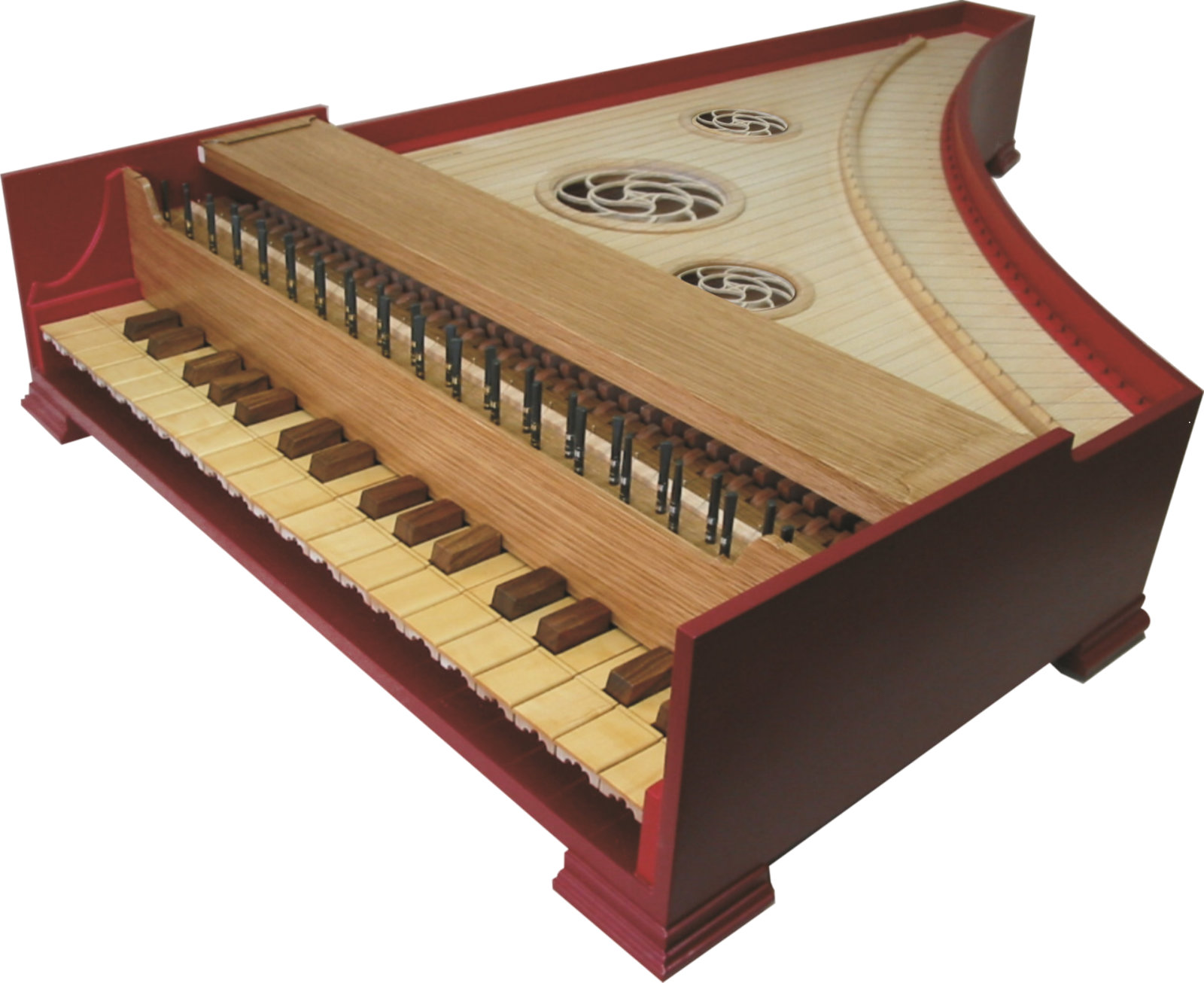

Clavicymbalum
Keyboard Instruments
Medieval to Pre-Modern (1001–1900)
Western Early Music Instruments
Video
The clavicymbalum is a historical keyboard instrument and an important ancestor of the harpsichord. It is classified as a stringed keyboard instrument where the strings are plucked, rather than struck, to produce sound. The clavicymbalum is essentially a psaltery with keys attached, allowing the performer to pluck the strings through mechanical action rather than directly with fingers. Unlike modern keyboard instruments, it lacks dampers, so the strings resonate freely until the sound naturally fades. This feature gives it a distinct tonal quality, characterized by sustained and ringing notes. The instrument typically has a triangular shape, with one side curved, and its keyboard often spans two octaves.
Type of Instrument
The clavicymbalum belongs to the family of early keyboard instruments and is considered a precursor to the harpsichord. It falls under the category of “plucked string instruments” within the broader classification of keyboard instruments. Unlike the clavichord, which produces sound by striking strings, or the piano, which uses hammers, the clavicymbalum relies on mechanical plucking. This method of sound production places it in close relation to other early plucked instruments like the spinet and virginal.
History of the Clavicymbalum
The origins of the clavicymbalum can be traced back to medieval Europe, with its earliest known reference appearing in 1323 in a work by Johannes de Muris. The instrument was described as a “monochordium” with a triangular form and a two-octave keyboard. By the 15th century, it was recognized as one of three primary types of keyboard instruments alongside the dulce melos (an early piano) and the clavicordium (clavichord). The writings of Henri-Arnault de Zwolle (1438–1446) provide detailed descriptions of its design and construction.
The clavicymbalum was primarily used in Europe during the late Middle Ages and early Renaissance periods. Its development coincided with advancements in musical theory and practice, particularly in polyphony and harmonic exploration. However, as more sophisticated instruments like the harpsichord emerged, the clavicymbalum gradually fell out of favor.
Construction and Design
The construction of the clavicymbalum reflects its role as an early experiment in keyboard mechanics. Its triangular body housed strings stretched over a soundboard, much like a psaltery. Keys were added to enable players to pluck individual strings mechanically. The absence of dampers allowed for continuous resonance, which contributed to its unique sonic character but also limited its dynamic control. The instrument’s design often included wooden frames and metal strings, tuned using pegs similar to those found on lutes or viols. The triangular shape was not only functional but also symbolic, reflecting geometric principles that were highly regarded in medieval art and science.
Types of Clavicymbalum
While there is limited evidence of significant variations in clavicymbalum design, historical sources suggest that different models may have existed based on regional preferences or specific musical requirements. Some versions might have incorporated additional keys or extended ranges to accommodate evolving musical styles.
Characteristics
The clavicymbalum is notable for its sustained tones and bright timbre. Its lack of dampers creates an ethereal quality as notes blend into one another. This characteristic made it well-suited for early polyphonic music but less adaptable to later styles requiring more precise articulation. In terms of playability, the clavicymbalum required careful tuning and maintenance due to its delicate construction and reliance on mechanical components. Players needed skill not only in performance but also in understanding its unique acoustical properties. In summary, the clavicymbalum holds a significant place in the history of musical instruments as an innovative precursor to modern keyboards. Its design and function reflect both the technological ingenuity and artistic aspirations of its time. Though largely forgotten today, it remains an important link in the evolution of Western music.
Playing Techniques and Sound Modifications
The clavicymbalum, an early ancestor of the harpsichord, employed a unique mechanism where keys plucked strings, producing sustained tones until the sound naturally faded. Unlike modern keyboard instruments, it lacked dampers, which meant that players had to adapt their technique to control resonance. The absence of dampers allowed for a continuous ringing tone, requiring performers to carefully manage articulation and phrasing to avoid excessive overlapping of sounds. Playing techniques were influenced by the instrument’s triangular or harp-like shape, as described in early sources like Johannes de Muris’ 1323 work. Players often emphasized melodic clarity and rhythmic precision due to the limited dynamic range and tonal color of the clavicymbalum. Additionally, variations in touch could slightly alter the attack of the plucked strings, providing subtle expressive possibilities.
Sound modifications on the clavicymbalum were minimal compared to later keyboard instruments. However, players could experiment with tuning systems (such as meantone temperament) to achieve different harmonic effects. The instrument’s design also allowed for variations in string material and tension, which could influence its tonal quality.
Applications in Music
The clavicymbalum was primarily used in medieval and early Renaissance music. It served as a solo instrument for performing polyphonic works and as an accompaniment for vocal music. Its clear and resonant tone made it suitable for contrapuntal compositions, allowing individual voices to be distinctly heard. In ensemble settings, the clavicymbalum often played a supporting role, providing harmonic foundation and rhythmic stability. It was particularly favored in courtly and ecclesiastical contexts, where its refined sound complemented sacred and secular repertoires. Composers of the time likely wrote pieces specifically tailored to its capabilities, though much of this music has not survived. The instrument also played a role in the development of keyboard music traditions. Its design influenced subsequent instruments like the harpsichord and clavichord, shaping the evolution of keyboard performance practices.
Most Influential Players
While specific performers associated with the clavicymbalum are not well-documented due to its early historical period, its significance is reflected in the writings of theorists like Henri-Arnault de Zwolle and Johannes de Muris. These figures contributed to our understanding of the instrument’s construction and musical applications. Henri-Arnault de Zwolle’s detailed descriptions of keyboard instruments from 1438–1446 highlight the clavicymbalum’s importance as one of three primary types of early keyboards. His work provided valuable insights into its mechanism and role within medieval music culture. Additionally, composers such as Johannes Ciconia and Guillaume de Machaut may have been familiar with instruments like the clavicymbalum, given their prominence during this era. Although direct connections are speculative, their polyphonic compositions align with the capabilities of this instrument.
Maintenance and Care
Maintaining a clavicymbalum required careful attention to its strings, keys, and wooden frame. Regular tuning was essential due to fluctuations in string tension caused by environmental factors like temperature and humidity. Tuning pins needed periodic adjustment to ensure accurate pitch. The strings themselves were typically made of metal or gut and required replacement when worn or broken. Proper storage was crucial to prevent damage from moisture or pests that could compromise the wooden structure or strings.
The quills or plectra used for plucking strings also needed regular inspection and replacement. These were often made from bird feathers or leather and could wear down over time, affecting sound quality.
To preserve its resonance, the soundboard had to remain free from cracks or warping. Craftsmen would occasionally reinforce or repair structural components to maintain optimal performance. Overall, caring for a clavicymbalum demanded both technical knowledge and meticulous attention to detail.
Cultural Significance
The clavicymbalum holds a significant place in the history of Western music as a precursor to modern keyboard instruments like the harpsichord and piano. Its invention marked a pivotal moment in musical innovation by combining elements of stringed instruments (like the psaltery) with a mechanical keyboard interface. Culturally, it symbolized advancements in craftsmanship and musical theory during the Middle Ages and Renaissance. Its association with courtly life and sacred music underscores its role as both an artistic and social artifact. The clavicymbalum also reflects broader trends in medieval music-making, including the increasing importance of polyphony and instrumental accompaniment. It bridged traditional practices with emerging technologies that would shape music for centuries to come.
Today, it is celebrated by historians and musicians as an emblem of early keyboard development. Reconstructions of clavicymbala allow modern audiences to experience its unique sound and appreciate its contribution to musical heritage.
FAQ
What is the history of the Clavicymbalum?
The Clavicymbalum, a forerunner of the harpsichord, originated in the 14th century in Europe. It was an early keyboard instrument with plucked strings. It evolved from the psaltery and was described by Henri Arnaut de Zwolle. The instrument was used mainly in court and sacred music.
What materials were used in the construction of the Clavicymbalum?
The Clavicymbalum was primarily built from wood, such as spruce or cypress, for resonance. The strings were made of brass or iron, plucked by quills or leather plectra. The keys were crafted from wood, often with ivory or bone coverings. The soundboard enhanced its tonal quality.
What are the main features of the Clavicymbalum?
The Clavicymbalum featured a plucked-string mechanism similar to the harpsichord. It had a compact wooden body with a keyboard layout. The instrument produced a bright, resonant sound with limited dynamics. It was mainly used in early Renaissance music before evolving into later keyboard instruments.
 Links
References
Other Instrument
Categories



















