Overview
The salamuri is a traditional Georgian end-blown flute widely used in rural and regional musical traditions. It is particularly associated with eastern Georgian regions such as Kakheti and Kartli, though related forms are found throughout the country. The instrument is valued for its clear, penetrating tone and its ability to articulate lively dance melodies as well as pastoral tunes.
Unlike transverse flutes such as the dizi or the bansuri, the salamuri is played vertically. It belongs to the broader family of duct or fipple flutes in its most common modern form, although older variants without a duct also exist.
Classification
- Instrument family: Aerophone
- Sub-family: End-blown flute (duct flute in common form)
- Hornbostel–Sachs: 421.221.12 (end-blown flute with duct)
- Finger holes: Commonly 6 to 8
- Playing position: Vertical
In its duct-flute form, the salamuri produces sound when air is directed through an internal channel against a sharp edge. Some historical examples are rim-blown rather than ducted, though the duct version is more common in contemporary practice.
Historical Background
The salamuri has deep roots in Georgian folk culture. While exact dates are uncertain, archaeological and ethnographic evidence suggests that end-blown flutes have existed in the Caucasus for many centuries. The instrument was historically used by shepherds and rural musicians, often accompanying dances, festive gatherings, and outdoor celebrations.
Over time, the salamuri became integrated into regional ensembles and staged folk performances. It remains one of the most recognizable wind instruments in Georgian traditional music.
Structure and Construction
Body
The salamuri is typically made from wood, though bone and reed versions have also been documented. The body is a straight cylindrical tube, relatively narrow, and usually ranges between approximately 25 and 40 centimeters in length depending on pitch and regional style.
Mouthpiece
In the common duct-flute version, the mouthpiece contains an internal channel that directs air toward a labium edge. This makes tone production relatively accessible compared to rim-blown flutes, which require more precise embouchure control.
Finger Holes
Most salamuri instruments feature between six and eight finger holes on the front. Some variants include a thumb hole on the back. The number and placement of holes influence tuning systems and regional stylistic differences.
Tuning and Range
The salamuri is typically tuned diatonically. Chromatic notes can sometimes be produced through half-holing or breath adjustment, though the instrument is primarily designed for modal folk repertoire rather than fully chromatic music.
The range commonly spans around two octaves, depending on construction and player technique. Overblowing allows access to the upper register.
Playing Technique
The instrument is held vertically with both hands covering the finger holes. In duct versions, airflow is directed automatically by the internal channel, allowing the player to focus on articulation and finger movement.
The salamuri is capable of:
- Fast dance articulation
- Grace-note ornamentation
- Rhythmic melodic phrasing
Its tone is generally bright and direct, making it well suited for outdoor performance and ensemble settings.
Musical Role and Ensemble Context
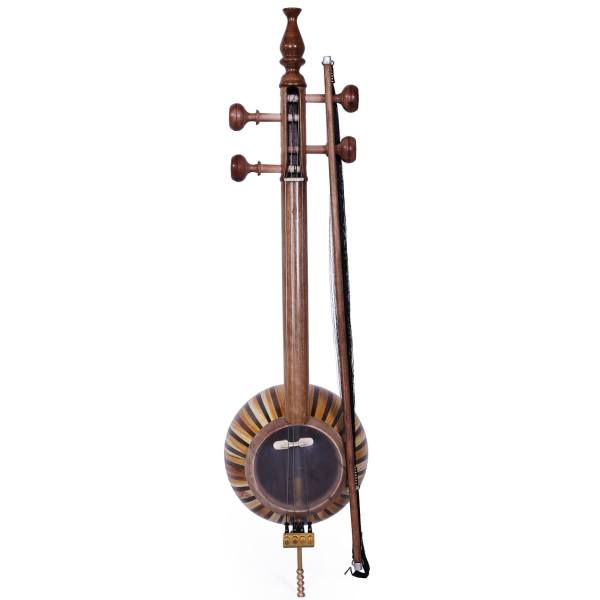
The salamuri appears in solo settings as well as in ensemble contexts. It may accompany Georgian dances, festive gatherings, and staged folk ensembles. In some settings, it appears alongside instruments such as the Ch’uniri and the changi.
While the changi provides harmonic support and the Ch’uniri offers bowed drone textures, the salamuri often carries the principal melodic line.
Construction Materials
- Body: Wood (commonly apricot, plum, or other local hardwoods)
- Mouthpiece block: Wood insert forming the duct
- Finish: Often natural oil or minimal varnish
Traditional craftsmanship emphasizes stable wood selection and careful bore shaping to maintain tuning consistency.
Maintenance and Care
Because the salamuri is usually made of wood, it is sensitive to humidity and temperature changes. After playing, moisture should be removed from the bore. Sudden environmental shifts may cause cracking or tuning instability.
Proper storage in a dry, stable environment helps preserve both structural integrity and tonal clarity.
FAQ
FAQs
What is the salamuri?
The salamuri is a traditional Georgian end-blown flute, commonly constructed as a duct flute, and widely used in regional folk music and dance traditions.
How many holes does a salamuri have?
Most salamuri instruments have between six and eight finger holes, and some versions include a thumb hole on the back.
Where is the salamuri traditionally played?
It is traditionally played in eastern Georgian regions such as Kakheti and Kartli, and appears in dance, festive, and folk ensemble contexts throughout Georgia.
Other Instrument
Categories