Zhu
Plucked Instruments
Ancient (Pre-0 CE)
East Asian Traditional Instruments
The zhu is an ancient Chinese musical instrument, notable for its unique construction and historical significance in the development of Chinese music. There are two distinct instruments known as “zhu” in Chinese musical history: one is a stringed zither, and the other is an idiophonic percussion instrument. The stringed zhu, often referred to in historical texts and archaeological findings, is a type of struck zither with a narrow, slightly convex wooden body and multiple strings. The percussion zhu, in contrast, is a ritual instrument used in ceremonial music, constructed as a wooden box and played by striking its interior surface with a stick.
Type of Instrument
The stringed zhu belongs to the family of zithers, specifically a half-tube or rectangular zither that is played by striking the strings with a slender stick rather than plucking them. This places it in the broader category of chordophones, but its method of sound production is distinct from the more commonly plucked or bowed zithers. The percussion zhu is classified as an idiophone, an instrument that produces sound primarily by the vibration of its own material, without the use of strings or membranes. It is used to mark the beginning of ritual music pieces in ancient Chinese court and religious ceremonies.
History of Zhu
The zhu originated in China, on the continent of Asia, and its earliest known forms date back to the Warring States period (475–221 BCE). Archaeological discoveries have placed the instrument in use as early as the 5th century BCE, with notable examples unearthed in the tomb of Marquis Yi of Zeng in Hubei province, central China. The zhu gained popularity during this period, especially in the courts of the various states, and remained in use through the Sui and Tang dynasties (6th to 10th centuries CE). However, it gradually fell out of favor and disappeared from common use after the Tang dynasty, with little evidence of its presence beyond the Song dynasty. The percussion zhu has an even older lineage, with references tracing back to the Zhou dynasty (1046–256 BCE). It was an integral part of the yayue, or ritual music, of the time, and its use was closely associated with ceremonial practices and Confucian rituals.
Construction and Physical Structure
The stringed zhu is constructed from wood, typically fashioned into a long, narrow, and slightly convex body. Surviving examples range in length from about 93 cm to 118 cm. The instrument originally had five strings, which were stretched over movable bridges at both ends of the body. These strings were made from silk or gut, and the instrument was played by striking them with a slender bamboo stick. The bridges allowed for some adjustment of pitch, though the range was relatively limited. Later variations of the zhu featured a wider body and an increased number of strings, sometimes up to thirteen, to expand its musical capabilities. The playing technique involved holding the instrument with the left hand, pressing the strings to alter pitch, while striking them with the right hand using the stick. This method produced a percussive, resonant sound distinct from plucked zithers. The physical structure of the zhu bears similarities to other ancient Chinese zithers such as the qin, se, and zheng, but its method of sound production sets it apart.
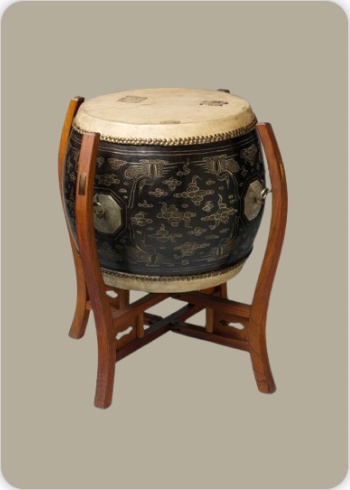
The percussion zhu, on the other hand, is constructed as a wooden box, often painted red or elaborately decorated. The box tapers from top to bottom, and the performer uses a wooden stick to strike the inner bottom surface through an opening at the top. The instrument was designed to produce a resonant, percussive sound that signaled the beginning of a musical piece in ritual contexts. Its construction was both functional and symbolic, reflecting its role in ceremonial music.
Types of Zhu
There are two primary types of zhu recognized in Chinese musical history:
Stringed Zhu: This is the struck zither described above, with its origins in the Warring States period. Variations in the number of strings and body shape occurred over time, with some later versions featuring a wider body and more strings. However, the essential characteristics of a narrow, convex body and struck strings remained consistent.
Percussion Zhu: This idiophonic instrument was used in ritual music, particularly in the context of Confucian ceremonies. Its design as a wooden box distinguishes it from the stringed zhu, and its function was primarily ceremonial, used to mark the beginning of musical performances.
Additionally, there are regional and historical variations in the construction and use of the zhu, influenced by local musical traditions and the availability of materials. Some related instruments, such as the Korean chuk, share similarities with the Chinese percussion zhu and continue to be used in ritual music outside China.
Characteristics
The zhu is characterized by several distinctive features:
Unique Playing Technique: The stringed zhu is played by striking the strings with a stick, a technique that differentiates it from other zithers, which are typically plucked or bowed. This method produces a sharp, percussive tone with a limited melodic range.
Construction Materials: The use of wood for the body and silk or gut for the strings reflects traditional Chinese instrument-making practices. The bridges, often movable, allowed for some adjustment of pitch and timbre.
Role in Music: The stringed zhu was used both as a solo instrument and in ensembles, particularly during the Warring States and Tang dynasties. Its percussive sound made it suitable for lively, rhythmic music, while its limited range restricted its use in more complex compositions.
Ceremonial Function: The percussion zhu played a significant role in ritual music, marking the beginning of performances in Confucian and court ceremonies. Its symbolic function was as important as its musical contribution.
Obsolescence and Legacy: Both types of zhu eventually fell out of common use, with the stringed zhu disappearing after the Tang dynasty and the percussion zhu surviving mainly as a ceremonial artifact. However, their influence can be seen in the development of later Chinese zithers and ritual instruments.
Archaeological Significance: Discoveries of zhu in ancient tombs, such as those of Marquis Yi of Zeng and in Changsha, provide valuable insights into the musical culture of early China. These findings have helped reconstruct the instrument’s appearance and playing technique, even as direct historical records remain scarce.
Playing Techniques and Sound Modifications
The zhu was an ancient Chinese string instrument, classified as a zither, with a long and slim body, typically featuring five strings. Its playing technique was distinct from other zithers. Rather than being plucked or bowed, the zhu’s strings were struck with a slender bamboo stick. This method of sound production places the zhu in a unique position among Chinese string instruments, resembling the technique of hammered dulcimers more than the finger-plucked guqin or guzheng. Archaeological evidence and pictorial representations from the Han dynasty suggest that the musician would hold the neck of the instrument in the left hand, pointing it away from the body, and strike the strings with a stick held in the right hand. The left hand could press down on the strings to alter their pitch, although the range of pitch modification was limited—likely only one or two steps above the open string pitch due to the relatively short string lengths.
Sound modifications on the zhu were achieved by a combination of striking technique and limited finger pressure. The use of movable bridges, as suggested by some illustrations and archaeological finds, may have allowed for some adjustment of tuning and timbre, though the extent of this is unclear. The instrument’s sound would have been characterized by a percussive attack and a relatively short sustain, with tonal variation depending on where the stick struck the string and the pressure applied by the left hand. The stick’s material and shape could also influence the timbre, allowing for subtle changes in the instrument’s voice. This style of performance gave the zhu a distinctive, rhythmic quality, suitable for both solo and ensemble playing.
Famous Compositions
Due to the zhu’s disappearance after the Tang dynasty and the scarcity of written musical scores from its era, no specific compositions for the zhu have survived to modern times. The instrument was popular during the Warring States period and continued to be played through the Sui and Tang dynasties, but it faded from use and was lost during the Song dynasty. While the zhu was likely used in court music, entertainment, and possibly ritual contexts, the details of its repertoire are largely unknown. Ancient Chinese music was often transmitted orally, and the lack of surviving notation means that any specific pieces associated with the zhu have been lost to history. However, the presence of the instrument in important archaeological sites such as the Tomb of Marquis Yi of Zeng suggests that it played a role in the sophisticated musical culture of its time.
Most Influential Players
Among the few names associated with the zhu, Gao Jianli stands out as the most famous player. Gao Jianli was a citizen of the state of Yan during the Warring States period and is noted in historical records for his exceptional skill on the zhu. His reputation was such that he was invited to perform for Qin Shi Huang, the first emperor of China. Gao Jianli’s story has been preserved in Chinese historical and literary tradition, and he remains the only well-documented virtuoso of the instrument. His performances were said to have deeply moved his audiences, and his association with the zhu has become legendary. Beyond Gao Jianli, the names of other zhu players have not been recorded, reflecting both the instrument’s ancient origins and the fragmentary nature of early Chinese musical history.
Historical Performances or Concerts
The zhu was used in a variety of musical settings in ancient China, including entertainment and ritual contexts. It first appeared no later than the Warring States period and was found in both solo and ensemble performances. The discovery of zhu instruments in the tomb of Marquis Yi of Zeng, dated to 433 BC, provides evidence of its role in the elaborate musical ensembles of the time. These ensembles included a wide array of instruments, reflecting the high level of musical sophistication in the courts of ancient China. The inclusion of the zhu in such a prestigious tomb suggests that it was valued both for its musical qualities and its symbolic significance.
Later, during the Sui and Tang dynasties, the zhu continued to be played, though it gradually fell out of favor and was lost by the Song dynasty. There are no detailed records of specific performances or concerts featuring the zhu, but its presence in important archaeological contexts indicates that it was an integral part of ceremonial and possibly courtly music. The instrument’s role in these settings would have been as both a melodic and rhythmic contributor, supporting the ensemble with its distinctive struck-string sound.
Maintenance and Care
As an ancient instrument, the zhu required careful maintenance to preserve its sound quality and playability. The body of the zhu was typically made from wood, often with a slightly convex surface, and the strings were originally made from silk or gut. Regular care would have involved keeping the wooden body free from moisture and pests, as well as ensuring that the strings remained taut and in good condition. Silk strings are particularly sensitive to changes in humidity and temperature, so zhu players would have needed to store the instrument in a stable environment. The bamboo stick used for striking the strings would also require attention, as it could wear down or splinter with use. Periodic replacement or smoothing of the stick would have been necessary to maintain a consistent tone and prevent damage to the strings. Movable bridges, if present, would need to be checked for proper placement and stability, as their position could affect tuning and intonation. Although the specific maintenance routines of ancient zhu players are not documented, these general practices can be inferred from the care required for similar traditional string instruments.
Interesting Facts and Cultural Significance
The zhu occupies a unique place in the history of Chinese music. It is one of several ancient zithers, alongside the qin, se, and zheng, but it is distinguished by its struck-string technique. The instrument’s design, with a narrow, slightly convex body and five or more strings, reflects early innovations in Chinese lutherie. Surviving examples of the zhu vary in length from about 93 to 118 centimeters, and some feature movable bridges, indicating a degree of technical sophistication. One of the most interesting facts about the zhu is its archaeological rediscovery. Although the instrument disappeared after the Tang dynasty, twentieth-century excavations have uncovered several examples in tombs, including those of Marquis Yi of Zeng and in other sites in Hunan province. These finds have provided valuable insights into the construction and use of the zhu, as well as its place in ancient Chinese musical ensembles. Culturally, the zhu was part of the broader tradition of Chinese zithers, which have played a central role in Chinese music for millennia. The instrument’s use in both entertainment and ritual contexts highlights its versatility and importance. Its association with the legendary figure Gao Jianli adds a layer of historical romance, connecting the instrument to stories of artistry and political intrigue.
The zhu’s disappearance after the Tang dynasty is a reminder of the changing tastes and technologies in Chinese music. While other zithers like the guqin and guzheng have survived and evolved, the zhu remains a symbol of a lost musical heritage. Its rediscovery in modern times has sparked interest among musicologists and historians, who see it as a key to understanding the musical culture of ancient China.
Legacy and Influence
Although the zhu itself is no longer played, its influence can be seen in the development of other Chinese zithers. The techniques and design principles of the zhu likely informed the construction of later instruments, and its place in ancient ensembles set a precedent for the integration of struck and plucked strings in Chinese music. The instrument’s unique sound and playing style have inspired modern reconstructions and performances, particularly in the context of archaeological and historical research. The zhu also holds a place in the broader context of East Asian music. Its Korean counterpart, the chuk, continues to be used in Korean ritual music, demonstrating the instrument’s enduring legacy in the region. The zhu’s role in the ritual music of ancient China, particularly in the context of yayue (court music), underscores its cultural significance and its connection to the cosmological and philosophical ideas of the time.
Modern Rediscovery and Research
The twentieth-century rediscovery of the zhu through archaeological excavations has led to renewed interest in the instrument among scholars and musicians. The tomb of Marquis Yi of Zeng, in particular, has yielded important examples of the zhu, allowing researchers to study its construction and hypothesize about its playing techniques. These discoveries have contributed to a deeper understanding of ancient Chinese music and the diversity of instruments used in early ensembles.
Efforts to reconstruct the zhu and perform ancient music have faced significant challenges, given the lack of surviving scores and detailed descriptions. However, these attempts have provided valuable insights into the instrument’s sound and performance practice. Modern reconstructions, based on archaeological evidence and historical texts, aim to capture the essence of the zhu’s music, even if the original repertoire remains lost.
FAQ
What is the historical significance of the Zhu in Chinese music?
The Zhu is an ancient Chinese percussion instrument used in ritual court music. It dates back to the Zhou Dynasty (1046–256 BCE). It played a ceremonial role in Confucian rituals to mark the beginning of music. Over time, it became symbolic of tradition and formality in Chinese music history.
What materials are used to construct the Zhu instrument?
The Zhu is traditionally made of wood, often painted or lacquered with decorative patterns. It features a rectangular box design, open on one side. A wooden mallet is used to strike its inner surface. Its sound is produced by the hollow resonating chamber.
What are the main features and uses of the Zhu?
The Zhu is a percussion instrument used to signal the beginning of music in ancient Chinese rituals. Its main feature is a deep, resonant sound created by striking the wooden interior. It symbolizes the order of ritual performance. Though rarely used today, it holds cultural and historical importance.
 Links
References
- Zhu | Chinese, bamboo flute, folk music | Britannica
- Zhu (string instrument) - Wikipedia
- The Lost Melodies of Zhu - China Underground
- Strings Instruments in the Age of Confucius (PDF) - Hunter College
- Zhu (percussion instrument) - Wikipedia
- Profile: Reviving China's Zhuang ethnic instrument with modern beats
Other Instrument
Categories